The phonedog team takes a look at the iPad 2 and the Motorola Xoom (Android) Tablet. Head over to the next page to view the comparison video. Enjoy!
The phonedog team takes a look at the iPad 2 and the Motorola Xoom (Android) Tablet. Head over to the next page to view the comparison video. Enjoy!
This video is a test of the flash capabilities of four high end Android Phones:
Both the Motorola Atrix 4G and Samsung Galaxy S 2 pack dual core processors: the Tegra 2 1GHz in the former, and the 1.2GHz Exynos in the latter. In this video the guys at pocketnow runs benchmarks, check available RAM after start up, compare specs, see which one opens apps faster, and check web-browsing performance.
PhoneArena reviews the Motorola DROID X2. The Motorola DROID X2 is the successor of the Motorola DROID X. It will pack the same 4.3-inch screen but with qHD resolution, 1GHz dual-core processor, 512MB of RAM and 8MP camera.
*This list of Custom ROM is only for Motorola Droid X*
*Flash your device at your own risk*
(06/21/2010) [SS] CyanogenMod V7.1.0-RC0 (2.3.4)
(06/21/2010) [SS] Android Revolution HD 1.0.2
(06/21/2010) [SS] Virtuous Unity 1.25.0
(06/14/2010) [SS] CoreDroid V1.1 (2.3.3)
(05/31/2010) [SS] MDJ's ViVO Sense v.1.2
(05/17/2010) [SS] LPRemixHD v1.3.1 (2.3.3)(Sense2.1+3)
(05/05/2010) [SS] HawkyMod 1.0.0.2 (2.3.3)
(05/05/2010) [SS] AngerBread 0.2 (2.3.3)
(05/04/2010) [SS] Incredible S Shipped ROMs
*Most source links are from xda-developers forum*
*This list of Custom ROM is only for Motorola ATRIX 4G*
*Flash your device at your own risk*
(06/03/2011) [SS] GingerBlur v4.5
(05/18/2011) [SS] GladiAtrix 3 b0.2 (AT&T)(1.2.6)
(04/22/2011) [SS] GreyBlur v2.1
(04/16/2011) [SS] GladiAtrix2 v4.2.3 (1.57)
*Most source links are from xda-developers forum*
Permalink: http://goo.gl/Upz1P
*This list of Custom ROM is only for Motorola Droid*
*Flash your device at your own risk*
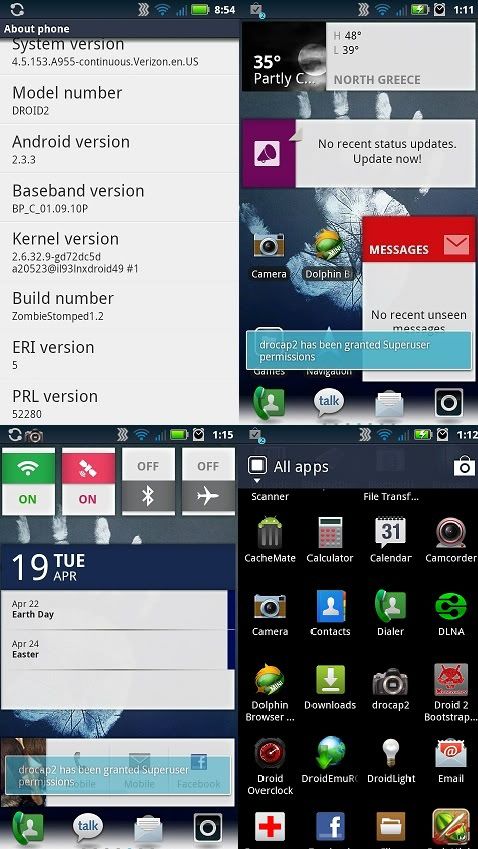
(04/23/2011) [SS] ZombieStomped 1.2
(01/22/2011) [SS] Cobalt 1.0
(01/19/2011) [SS] CCRom’s Tanzanite 2.0.2 BETA
(01/08/2011) [SS] Team DeFuse’s Fission 2.5.7
(01/07/2011) [SS] Team DeFuse’s Fusion 2.0 RC1
(12/28/2010) [SS] GummyJAR 2.5
*Most source links are from xda-developers forum*
Permalink: http://goo.gl/UV11b
*This list of Custom ROM is only for Motorola Droid*
*Flash your device at your own risk*
(05/22/2010) [SS] Liquid Gingerbread v1.9
(05/05/2010) [SS] CyanogenMod V7.0.3 (2.3.4)
(02/23/2010) [SS] Project Elite v5 (2.3)
(02/17/2010) [SS] gingerbread for droid (2.3)
(01/25/2011) [SS] MIUI 1.1.28
*Most source links are from xda-developers forum*
Permalink: http://goo.gl/EZQHv
*This list of Custom ROM is only for Motorola Milestone*
*Flash your device at your own risk*
(04/22/2011) [SS] MIUI Milestone 1.4.22 (2.3)
(04/18/2011) [SS] CyanogenMod V7.0.0 11.04.18b (2.3.3)
(04/18/2011) [SS] iceandfire v1.9 (CM7)(2.3.3)
(01/15/2011) [SS] HO!NO! CM7 11.04.18b (2.3.3)
(04/07/2011) [SS] The FroyoMOD v2.6.1b (2.2)
(04/07/2011) [SS] MotoFroyoSense v0.25v patch (2.2)
(10/06/2010) [SS] EclairMOD v0.3b (2.1)
*Most source links are from xda-developers forum*
Permalink: http://goo.gl/dN7KJ
*This list of Custom ROM is only for Motorola Droid X*
*Flash your device at your own risk*
(03/02/2010) [SS] rubiX Focused 2.0
(01/19/2011) [SS] CCRom’s Obsidian 2.0.1
(01/17/2011) [SS] Incredibly Re-EngineeredX v1.00
(01/11/2011) [SS] DarkSlide v4.2
(01/08/2010) [SS] Team DeFuse’s Fission 2.5.7 (AOSP)
(01/08/2010) [SS] Team DeFuse’s Fusion 2.0 RC1
(12/28/2010) [SS] GummyJAR 2.5 (AOSP)
(12/20/2010) [SS] TranQuility 3.6
(12/02/2010) [SS] Unleashed 3.0 Alpha (AOSP)
(12/01/2010) [SS] Rumm Rx v1.0
*Most source links are from xda-developers forum*
Permalink: http://goo.gl/q1W8b
*This is the list for MIUI ROM from the Far East*
*If anything would happened I won’t be held responsible*
*Flash your device accordingly*
Supported devices capable of running MIUI ROM:
(01/14/2011) Google Nexus One 1.1.14
(01/18/2011) HTC Desire CDMA 1.1.14.0
(01/29/2011) HTC Desire GSM 1.1.28
(01/17/2011) HTC Desire HD 1.1.15
(02/13/2011) HTC EVO 4G 1.2.11
(12/04/2010) HTC HD2 0.12.03
(02/13/2011) HTC Incredible 1.2.11
(02/02/2011) Motorola Droid 1.1.28.0
(01/31/2011) Motorola Milestone 1.1.28
*Most source links are from MIUI dev forum*
In Q3 2010, the worldwide smart phone market grew an impressive 95% over the same quarter a year ago to 80.9 million shipped units. Nokia retained its leadership position, albeit by a diminished margin, with a 33% share of the market. Apple’s healthy performance this quarter saw it achieve a 17% share worldwide, a little ahead of RIM, which held a 15% share this quarter. In the world’s largest smart phone market, the US, Apple ousted RIM from the top spot, seizing a 26% share as iPhone shipments continued unabated. RIM has also launched its latest generation smart phone, the Torch, though it only saw half a quarter’s shipments in the US. But the plethora of smart phones running the Open Handset Alliance’s (OHA’s) Android platform meant that Canalys’ final published country-level data shows that it took the lead in the US market by operating system (OS), with a 44% share.
As well as the positive picture in the US, Canalys’ detailed country level smart phone research has consistently highlighted the importance of, and differences in, ‘emerging markets’. For example, in what are now being called the ‘BRIIC’ countries (Brazil, Russia, India, Indonesia and mainland China), smart phone shipments increased by 112% year-on-year, faster than the market overall, and each country individually saw strong growth. Nokia was the leading vendor in all five BRIIC markets in Q3 2010, benefiting from its global reach and channel relationships. In India, for example, Nokia held a 65% share of the smart phone market, and grew its shipments 208% year-on-year to 1.1 million units. The combination of affordable smart phones and its Ovi suite, which offers e-mail and messaging, navigation and music services, continues to prove popular in India, with products such as 523x series of smart phones performing well.
Despite ongoing discussions with the Indian authorities over the monitoring of encrypted communications, RIM has also continued to grow its business in the country and held an 18% share of the market in Q3 2010, with volumes up 412%. ‘For RIM, aggressively priced BlackBerry smart phones, such as the Curve 8520, have helped drive volumes across emerging markets, aided by its engagement in substantial marketing activities. It remains the number one smart phone vendor in Latin America, where it holds nearly 40% of the market,’ said Chris Jones, Canalys Principal Analyst. ‘Where smart phone growth in mature Western markets has been driven by high-end products, in many emerging markets where disposable income is more constrained, growth is being driven by good-quality products that can attract mass-market volumes in the mid-tier of the market. To succeed in these markets, vendors need to offer smart phones that provide consumers with the same ability to engage with the locally relevant mobile applications and connected services that consumers want to use, but at a more locally accessible price.’
Once again this quarter, it was devices running the Android platform that proved the greatest driver of growth in the worldwide market, up 1,309% year-on-year from 1.4 million in Q3 2009 to more than 20.0 million units in Q3 2010, forming a quarter of the market share. ‘With Samsung, HTC, Motorola and Sony Ericsson all delivering large numbers of Android devices, and with focused efforts from many other vendors, such as LG, Huawei and Acer, yielding promising volumes, the platform continues to gather momentum in markets around the world,’ said Canalys Senior Analyst Pete Cunningham. ‘Android has been well received by the market and in some geographies it is becoming a sought-after consumer brand. It has rapidly become the platform to watch, and its growing volumes will help to entice developers, ensuring consumers have access to an increasingly rich and vibrant mobile content and application ecosystem. Vendors are now delivering Android devices across a broad range of price points, from high-end products such as the Samsung Galaxy S or HTC Desire, to aggressively priced devices such as the LG GT540 Optimus or the Huawei built Vodafone 845, ensuring that Android devices are available and affordable to consumers on almost any budget.’
Driven by Nokia, the Symbian Foundation retained its position as the leading smart phone OS vendor worldwide. Of the 56 named countries that Canalys tracks, it is still the number one OS vendor in 37 of them because of Nokia’s dominance, plus in Japan, where its position is supported by Fujitsu and Sharp. The Symbian Foundation has been in a recent state of flux, with a streamlining of the workforce and the departure of its Executive Director, Lee Williams, along with the withdrawal of support from Samsung and Sony Ericsson. But it still has continued backing from the Japanese vendors and dedication from Nokia to its ongoing development. The launch of Nokia’s new range of Symbian devices, particularly the N8, will give a boost to its holiday season shipments, and the outlook into 2011 remains positive as Nokia aims to push Symbian devices further into the mid-tier of the market to attract mass-market volumes. ‘There has been a lot of speculation about whether Nokia will adopt another platform, but that looks highly unlikely. Its current strategy is clear and makes sense,’ added Pete Cunningham. ‘But Nokia still lacks a truly high-end product to compete against the iPhone and leading Android devices. The market is moving quickly and Nokia urgently needs to deliver an exciting and genuinely differentiated, high-end flagship MeeGo device early next year to regain its reputation as an innovative technology leader, and to retain its leadership position in the market.’
Devices running Microsoft’s OS accounted for just 3% of worldwide smart phone shipments in Q3 2010, though with the launch of Windows Phone 7 devices, the outlook for the fourth quarter and beyond is significantly improved. ‘Windows Phone 7 is streets ahead of earlier iterations and provides a vastly improved user experience that will pleasantly surprise many people when they come to use it. The integration of Microsoft service assets, such as Xbox Live, Bing, Zune and Office, greatly strengthens the proposition and we are confident that the initial array of products will perform well,’ said Chris Jones. ‘But the big challenge will be for handset vendors to differentiate their devices sufficiently given the restrictions Microsoft has placed on customizing the user interface, and its relatively demanding minimum hardware requirements, which will confine devices to the higher end of the market. The market is also awaiting the platform’s availability in non-roman languages to support its expansion into important emerging markets. Failure to deliver this soon will restrict the volume opportunity.’
Canalys analysts in Asia Pacific, the Americas and EMEA are available for press interviews on topics related to mobile devices and the growing ecosystem for mobile applications and services. To arrange an interview, please send a request to press@canalys.com. Analyst biographies, with photos, are available here.
The shipment estimates discussed in this release come from the market-leading Canalys Smart Phone Analysis services. Canalys offers services looking at the markets by country in Asia Pacific, North and Latin America, and EMEA, as well as providing worldwide market overviews and analysis of consumer and enterprise end-user attitudes and preferences toward mobile applications, devices and services.
Canalys specializes in delivering high-quality market data, analysis and advice to the world’s leading technology vendors. It is recognized as a key provider of continuous advisory services and confidential custom projects for marketing managers and strategists within blue-chip IT, telecoms, navigation and consumer electronics companies. It has unrivalled expertise in routes to market for all kinds of high-technology products and services and provides worldwide market data and trends analysis. Canalys does not release preliminary, incomplete data and uses consistent definitions and methodologies to ensure total consistency across all of the market data that appears in its services. The company publishes its final market data every quarter for every country tracked simultaneously on the same day.
Cross posted from Canalys
| Nexus One (Passion) | STABLE 7.0.3 | RC4 7.0 |
| Nexus S (Crespo) | STABLE 7.0.3 | RC4 7.0 |
| HTC Aria (Liberty) | STABLE 7.0.3 | RC4 7.0 |
| HTC Click (Tattoo) | STABLE 7.0.3 | RC4 7.0 |
| HTC Dream (G1)/Magic (MT3G) (U) | STABLE 6.1.0 | XDA 7.0 |
| HTC Desire (Bravo) CDMA | STABLE 7.0.3 | RC4 7.0 |
| HTC Desire (Bravo) GSM | STABLE 7.0.3 | RC4 7.0 |
| HTC Desire HD/Inspire | STABLE 7.0.3 | RC4 7.0 |
| HTC Desire Z / G2 (Vision) | STABLE 7.0.3 | RC4 7.0 |
| HTC EVO (Supersonic) | STABLE 7.0.3 | RC4 7.0 |
| HTC EVO Shift (Speedy) | STABLE 7.0.3 | RC4 7.0 |
| HTC Hero CDMA (Sprint) | STABLE 7.0.3 | RC4 7.0 |
| HTC Hero GSM | STABLE 6.1.0 | BETA 7.0 |
| HTC Incredible | STABLE 7.0.3 | RC4 7.0 |
| HTC Legend | STABLE 7.0.3 | RC4 7.0 |
| HTC myTouch 4G (Glacier) | STABLE 7.0.3 | RC4 7.0 |
| HTC Slide (MT3G Slide) | STABLE 7.0.3 | RC4 7.0 |
| HTC Wildfire (Buzz) | STABLE 7.0.3 | RC4 7.0 |
| LG Optimus 2X/G2X | STABLE 7.0.0 | Nightlies |
| Motorola Cliq XT | STABLE 7.0.0 | RC1 7.0 |
| Motorola Droid (Scholes) | STABLE 7.0.3 | RC4 7.0 |
| Motorola Milestone (U) | STABLE 7.0.1 | RC4 7.1 |
| Samsung Galaxy S I9000 | STABLE 7.0.0 | Nightlies |
| Samsung Galaxy S Captivate | STABLE 7.0.0 | Nightlies |
| Samsung Galaxy S Vibrant | STABLE 7.0.0 | Nightlies |
| Geeksphone ZERO | STABLE 7.0.3 | RC4 7.0 |
| Geeksphone ONE | STABLE 7.0.3 | RC4 7.0 |
| ZTE Blade Variants | STABLE 7.0.3 | RC4 7.0 |
| Advent Vega | STABLE 7.0.0 | Nightlies |
| B&N Nook Color | STABLE 7.0.3 | RC4 7.0 |
| Viewsonic G-Tablet | STABLE 7.0.3 | BETA 7.0 |
| Commtiva z71 Variants | STABLE 7.0.3 | RC4 7.0 |
(U) – Unofficial support
Disclaimer: I do not own or involved in any way in the development of these awesome ROM series. I only providing links to these CyanogenMod ROMs straight from their forum. Do read carefully before you proceed in doing anything. I do not held responsible “for bricked devices, dead SD cards, thermonuclear war, or you getting fired because the alarm app failed.” Till next time, peace out and enjoy the awesome taste of vanilla Froyo courtesy of the CyanogenMod developers and its community.
Permalink: http://goo.gl/lHeyT
In this article, I will discuss all kinds of aspects of rooting your Android phone and the benefits that come with it.
Maybe you’ve heard about "rooting" a phone from a friend or read about it somewhere on the Internet. Maybe you even *kind of* know what it is but aren’t sure what you can do with it. Or maybe you are already running a rooted phone and looking for more ways you can utilize it. Whatever the case may be, this article is for you.
First, for the newbies, let me clarify what rooting is. Getting root or rooting your phone is the process of modifying the operating system on your device to grant you complete control over it.
This means you can overcome limitations that the carriers and manufacturers put on your phone, extend system functionality, and even upgrade it to a custom flavor of Android.
The name root comes from the Linux operating system world, where the most privileged user on the system (otherwise known as Administrator on Windows) is called root.
Now, I’d like to take a moment to dispel a common misconception and clarify one thing: rooting does *not* mean installing a custom ROM (a ROM is a modified, "aftermarket" OS).
Installing a ROM may require rooting first, but just rooting can be done in only a few minutes, keeping your stock OS otherwise completely intact.
Usually rooting is fairly simple – in most cases you can find several videos and articles on the web that explain how to do it on your specific phone model – just Google "YOURPHONEMODEL root".
Rooting is not something manufacturers or carriers approve of but they can’t really prevent it from happening because the rooting process usually exploits a vulnerability in the operating system code or device drivers and allows the "hacker" to upload a special program called "su" to the phone. This program, not present or requiring a password by default, is the one that provides root access toprograms that request it.
Now an obligatory warning: rooting your phone does run the risk of potentially bricking it (i.e. your phone could become nonfunctional) – so do your homework before attempting anything, unless you’re a fan of $500 paper weights.
Let’s check out some of the benefits of rooting your Android phone.
You have access to alter any system files, use themes, change boot images, delete annoying stock apps, such as Sprint’s NFL Mobile live and Nascar Sprint Cup Mobile, and other various native applications that might drive you crazy (Footprints, Voice Dialer, etc).
There is plenty of information on the web on how to accomplish this. Here is one example with instructions and some apps you can remove safely.
On most rooted Android devices, you can back up your entire system to an SD card, much in the same way you can image a hard drive. This is great if you’d like to try a new ROM, as you can back up your phone, wipe it completely, flash the new ROM, and if you don’t like it, you can just restore from your backup and your phone will be exactly how it was before you wiped it.
The easiest way to do this at the moment is by using ‘Rom Manager’ (easily installable from the Android Market), developed by famed Android developer Koush.
Rom Manager allows you to easily flash a custom recovery image which is what you will need in order to backup and restore your phone. The recovery image is a special program that can be booted into outside of the phone’s main operating system, sort of like the BIOS on a PC. By default, the recovery image on most Android phones only gives you a few options, mainly related to wiping the phone. Custom recovery images expand upon these options and usually include scripts that can do things like fix your file permissions, or allow you to flash custom ROM’s that the normal recovery image would otherwise reject.
Normally, flashing a custom recovery image requires some command line work, either on your PC, or on a terminal emulator directly on the phone, but Koush’s Rom Manager should automatically flash his custom recovery image (known as ClockworkMod Recovery) for you, provided you’re on one of the phones listed below.
In order to use Rom Manager, you’ll need to make sure you’re using one of the supported devices, and that it is already rooted. Here is the list, as of today:
Using Rom Manager is pretty simple. Download and install the application from the market, fire it up, and you’ll be prompted with a disclaimer. If you’re feeling brave, go ahead and hit continue. You’ll be prompted to allow the application superuser permissions during this process – make sure you allow it access.
The first thing you’ll need to do is flash the ClockworkMod recovery image that I mentioned earlier, which can be done right in the app (it’s the first option). Rom Manager should automatically find the latest version of the right image for your phone, download, and install it – the whole process is seamless.
After that is done, you can simply use the ‘Manage and Restore Backups’, and ‘Backup current ROM’ options to, well, backup your current ROM or restore from an existing backup. It’s that simple!
At Android Police, we always encourage supporting developers, so please check out Rom Manager Premium if you enjoyed the free version!
Move cache data to SD card
Moving cache data makes for a speedy system. Rooting allows you to save things like browser cache to your SD card to free up space. Its not too complicated a process, but does take a bit of skill. XDA Developer’s have instructions posted on their forum if you want to tackle the task, it is definitely worth it.
Move installed applications to SD card
Moving and storing apps on internal memory can significantly slow your device down. If you root, you can avoid that completely.
The easiest way to move applications to your SD card would be to flash a custom ROM that just does it for you (using an app called Apps2SD) – Cyanogen ROM is always a good choice.
The Android custom ROM scene started growing shortly after the first Android phone, the T-Mobile G1, was released. The ROMs that were initially available just offered a few tweaks here and there – access to developer only sections of the operating system, debugging information, and things of that nature.
Now, around 1 1/2 years after the release of the G1, the Android ROM community has grown immensely and ROMs have been developed for most of the Android phones currently on the market.
They’ve gone far beyond simple tweaks and can now give your phone an entirely new look and feel. There are ROMs that can make your phone fly by replacing the kernel with hyper-optimized versions or even overclocking the CPU. The possibilities are nearly limitless and attempting to cover all of the features of all the ROM’s available for all of the phones out there would be pretty much impossible. If you’re interested in flashing a custom ROM on your phone, your best bet is to hit the Googles, search for "phonename custom ROM", see what comes up. You’ll likely find at least one forum dedicated to hacking your phone with plenty of information to get you started.
Here at AndroidPolice, we’re planning a series of custom ROM reviews for as many phones as we can get our hands on. Stay tuned for updates!
Good luck and happy rooting!
Have you rooted your phone? If so, what are you running?
Source: Android Police

Introducing the Motorola Droid Pro on Verizon, the first second Android phone that came with a physical portrait layout keyboard, like the one on Blackberry line of phones (The first one is actually the Motorola Charm). Gizmodo called it “a Blackberry impregnated by Android”. It runs Android 2.2 with Motorola Blur. Along the the keyboard, you got a 3.1” touchscreen on top of that. This phone is powered by a 1GHz OMAP 3620, and 512MB of RAM plus 2GB of onboard storage. Other usual set of features include 2.4GHz N Wi-Fi, 5 megapixel camera with dual LED, can shoot ‘DVD quality video’, DLNA, and Bluetooth 2.1. It does have 3G mobile hotspot that can support up to 5 devices at a time. What interesting about this phone is that it is equipped with dual mode GSM/CDMA chip for global roaming in 200 countries around the world.
Update: (Official) Key features and specifications:
· Support for both Exchange e-mail and Gmail™ for business
· Corporate directory look-up, unified calendar for Enterprise and sync with Google Calendar™
· PC-like browsing with Adobe® Flash® Player 10.1 on a full, multi-touch, 3.1-inch brilliant display built on Android 2.2
· View, edit and share documents, including Microsoft Excel® spreadsheets, PowerPoint® presentations and Word® documents
· Built-in security features, including AuthenTec IPSec multi-headed VPN integration, remote wipe of device and SD card, and complex password support. Device and SD card encryption will be available in early 2011
· 3G Mobile HotSpot capabilities – Allows customers to connect up to five other Wi-Fi®-enabled devices and laptops
· Live widgets that stream e-mail messages to the home screen; customers can filter the widgets to separate work and home e-mail
· 5-megapixel camera with auto focus and dual LED flash as well as DVD-quality video
· 3G diversity antennae provides customers with enhanced data speeds and range
· Wi-Fi®-enabled DNLA® connectivity
· Android Market™ – Provides customers with access to more than 80,000 applications
· My Verizon and Backup AssistantSM support – Allows customers to manage their wireless accounts or their contacts from their phones
Check out this hands-on and screenshot by Engadget.
Sources: Engadget, Gizmodo, BGR, Android Police
Since its 2008 debut, Android has grown - not only meeting all of the functionalities of the iPhone, but besting it in nearly all aspects. Here is our list of the top 10 things Android does better than the iPhone.
Starting with version 1.0, Android has been able to run multiple applications at the same time regardless of whether they are system apps or apps from the Android Marketplace. The current version of iPhone OS does offer limited multitasking, but only allows native applications such as Mail, iPod and Phone to run in the background. Android users benefit greatly from this discrepancy, as they can receive notifications, listen to music, or even record GPS data without keeping the application open. Apple will try to level the playing field with iPhone OS 4, granting developers access to a small and limiting list of APIs that can run certain services in the background, but it's a long way from the true multitasking that Android has.
One of the key features Android has is a customizable home screen keeps active widgets right at your fingertips, always accesible and always visible - without having to launch an application first. There are widgets for just about every app in the Android Marketplace from playing music to checking the weather and keeping up to date on Facebook. Meanwhile iPhone users are force to flip through their app list to locate and launch each app. If you wanted to check the forecast, for example, you would have to find the app, launch it, and then wait for it to load. With Android, all of that information can be displayed directly on your home screen, never more than a finger swipe away.
It's true that Apple's App Store has over 180,000 applications, while the Android Marketplace has only just broken the 50,000 mark but Android's rapid growth and adoption give it the potential to catch up to the iPhone App Store. Android also has another advantage: a completely open market. Apple receives around 10,000 app submissions per week, yet many apps are overlooked because they appear too simple or denied because a similar app already exists. The Android Marketplace is driven entirely by its consumers, so the best app is the one that succeeds - not the first one to reach the market. In addition, the Android Marketplace doesn't censor its apps, so the possibilities are truly endless.
The iPhone has some trouble with notifications. Because it's restricted to pop-up notifications, it can only handle one at a time and because it lacks multitasking, applications must be open in order for them to make notifications. Android, on the other hand, has a convenient notification bar which displays an icon for every notification you have waiting. The notification bar can also be pulled downward to reveal more detail about each notification. Android also allows app developers to make notification details viewable from the lock screen, something the iPhone can only do with native applications.
Apple users are encouraged to "Think Different" but when it comes to the actual hardware, they don't get much choice. You can pick the color, either black or white, and you get to choose between the 16GB or the pricier 32GB version. Other than that, you're stuck with the 3.5-inch, 320x480 pixel display, 256MB of RAM, and 600MHz processor. Because Android is an open platform, manufacturers have the freedom to pair it with any hardware they want, like the Nexus One (with 3.7-inch, 480x800 pixel display, 512MB of RAM, and 1GHz Snapdragon processor) or the Motorola Droid which has a physical keypad. Obviously, available selections will vary by carrier - speaking of which....
AT&T truly is the iPhone's weakest link. The iPhone's success turned the country's fastest 3G network into a staggering mess of dropped calls and dodgy data connections. If you lust after an iPhone and live in an area with poor AT&T coverage, you're stuck struggling with low signal quality, slow data speeds, and missed calls. Android devices are available on every major cellular carrier (although AT&T only offers a single, somewhat underpowered, Android phone). Verizon has the Motorola Droid, Droid Eris, and Droid Incredible to start. T-Mobile has the Nexus One, MyTouch 3G, Behold II, and will soon carry the MyTouch Slide. And Sprint has the Hero, Moment, and plans for the very promising Evo 4G. No matter where you live, Android lets you pick the carrier that's best for you.
The iPhone can be Jailbroken for some additional functionality, like installing apps that aren't available in the App Store, but the overall experience is the same. You're still stuck with the same exact interface. Similar to the Jailbreaking movement, Android has a small community dedicated to building custom ROMs for Android devices. Not only do Custom ROMs bring the same functionality Jailbreaking does, but they also bring an additional level of customization to your phone. There are ROMs that port custom UIs from one device to another. Other ROMs strip down bulky features and optimize for speed. With Android, nothing is out of reach.
Smartphones have been gaining more and more functionality over the past few years: Wi-Fi, GPS, 4G, Bluetooth, etc. While these are all great and necessary additions, they have very adverse affects on battery life. In attempts to counter poor battery life, users have taken to toggling system settings like turning on Wi-Fi or 3G on only when they are needed. iPhone users are stuck digging around in the system settings every time they want to use the internet or a Bluetooth device. Android lets you use widgets to manage your settings directly from your home screen - and for those lesser-used settings that might not have dedicated widgets, you can also create shortcuts on your home screen to take you directly to the setting you want to change.
With Smartphones giving us constant connectivity, it's not surprising that the majority of our computerized lives are moving online. We have email for our messages, Flickr for our photos, Google Docs for our documents, and Facebook and Twitter for our social lives. Android offers the ability to integrate all of this natively. Your Gmail account can be automatically synchronized with your phone. Photos taken with your phone can be automatically uploaded to Flickr. Your phone can even be linked to your Facebook account and can sync your phone contacts with your Facebook friends - complete with profile images, email addresses, and phone numbers. The iPhone can do this only through use of third party apps, and is nowhere near as seamless to use as the Android alternative.
If you've ever thought about buying an iPhone, you have probably noticed the price tag. The older iPhone 3G costs $99 with a two-year commitment and performs sluggishly with the latest OS updates when compared to the 3GS (which will run you a whopping $199 with two-year agreement). Because Android is an open source platform, it is very cost effective to implement which means savings for the end user. Every major cellular carrier (except for AT&T) has at least one Android phone available free with two-year agreement. Of course these are lower end Android devices, but they are still comparable in performance to the iPhone 3GS. The most expensive Android phones (which significantly outperform the iPhone 3GS) are $199 with two-year contract.
Source: Gizmodo
Here are some of the cool things showcased and unveiled during the Consumer Electronic Show (CES) 2009, Jan 8-11 in Las Vegas
Cell phones & Smartphones
I think it is appropriate to start the review with the first touch-screen Palm, named Palm Pre, which won the award for Best of CES 2009. It's packed with lots of wonderful features and powered by Palm own OS, the long-waited Palm WebOS. It comes with Bluetooth 2.1, WiFi, a 3.1-inch screen, GPS, 3mpx camera and 8GB of storage, among other things. Along with a multitouch display, it also equipped with a slide-out full QWERTY keyboard. Just like the iPhone, you can pinch in and out to zoom the web pages, but sadly without flash support.
The Icephone by the Medical Phone is the world first tri-panel phone. It got two keyboard with one full QWERTY and the other is for navigation purposes just like a mini-notebook. Just like the common smartphones, it's equipped with 3mpx camera, WiFi and GPS. The unique features about this phone is that it comes with software that can store your own medical record, and being dubbed as 'a phone that could save your life'.
Sony Ericsson unveiled its C905 phone which have a 8.1mpx camera with 16x digital zoom, the highest so far Sony Ericsson produced. It is a slide phone and currently not available in the US but only in Europe and Asia.
Ever thinking about a phone with circular display? Well Motorola is the first to did so with their new phone, the AURA. It got 1.55 inch (in diameter) round LCD display with 16 million color and 300 dpi resolution, giving a rich, photographic display quality. The display lens is made of 62-carat sapphire crystal, one of the most scratch-resistant material on earth! The phone is a designer centric phone with stainless steel housing with aluminum keypad. AURA is a swivel phone.
There are rumors about the new Nokia N97 all over the net for the past months but now it's unveiled at CES 2009. The N97 have a 3.5-inch 16:9 touch screen (640x360px) with also a slipped out full QWERTY keyboard. It got 32GB internal memory, 5mpx camera, accelerometer, proximity sensor and 3.5mm jack, just like iPhone does. But what it does have compared to iPhone are FM receiver, flash supported web pages, and also video recording capability. We can say that this is the true iPhone contender for sure.
Save the best for the last. LG have announced the GD910, a prototype wristwatch that can make and take call, or in other words, it is a watchphone! Its so secret and sleek, there are no one can touch the watch except the LG representative! It has a touch screen interface, Bluetooth , 3G, speakerphone and a music player.
Computers & Hardware
Asus Eee PC, the netbook pioneer, have a new model for Eee netbook line, the T91. The 2-pound, 1-inch netbook features an 8.9 inch LES backlit panel and it runs on Intel Atom processor and Windows XP. The screen can be flip-out 180 degree and it is touch enable.
HP debuts its own ultraportable, the dv2 and dv3, that have 12.1inch and 13.3inch display respectively. They are the first netbook powered by AMD's Yukon platform, the rival of Intel Atom processor. It starts at 3.8 pound with an inch thick at thinnest point.
Ever think about wireless charging? Well PowermatUSA have successfully make a product that will wirelessly charging your devices like phone, mp3 player, portable gaming device and even a laptop, by using magnetic induction process. Available in Spring 2009.
Done with netbook and now lets talk big. I mean it when I said big. Lenovo W700DS is indeed a big and heavy laptop, weights more than 11 lbs (5kg). The best thing about this laptop is that its powered by Intel Quad Core processor, NVIDIA Quadro FX 3700M (1 GB) and got two hard drives. For the record, it is not the first laptop that powered by a Quad Core processor (Its Hypersonic Aviator EQ7). However, this laptop sets its own record for being the first laptop with two display; 17' 1920x1200 WUXGA TFT LCD and 10.6' 1280x768 TFT LCD. With a starting price of $3,663, this laptop is design for graphic and video professional.
Digital Photo & Video
Let start of this section with the cool Sony Cyber-shot DCS-G3. It is a 10mpx camera with nice looking black metal design and 4GB of internal memory. What nice about this camera is it have 3.5inch LCD and its touch screen! Another cool thing about this camera is that it got 802.11b/g wireless connectivity and you can simply upload your photos and videos to services like Photobucket, Picasa and Youtube on the go. You can get it online for $499.99!
Kodak unveils the new Z980 super zoom camera with 24x zoom. It is a 12mpx camera with 26mm wide angle lens and its also capable of recording HD video. What best about this camera is that it have a vertical shutter release and detachable vertical grip that can be seen in most professional camera like Nikon D3 and Canon Mark III.
Music & Video Player
Sony introduced its NWZ-X1051 walkman with internal capacity of 16GB and 32GB. It is the world first portable music player to have an OLED screen on it! It has 3-inch touch screen LCD plus WiFi, FM tuner and noise cancelling capability.
One of the highlight at iRiver booth was their new P7 PMP (Portable Media Player). It got intuitive user interface coupled with sleep design and 4.3-inch touchscreen display (480x272). It comes in three model of 4, 8, and 16GB. Other features include FM radio, full movie codec, SRS WOW sound equalizer and picture viewing capability.
Samsung updated it PMP line with the new P3. The P3 is really an update to the previous P2. It got 3-inch touch screen with gorgeous user interface and also Bluetooth connectivity that can be sync to other PMP for music sharing. The Bluetooth is also can be sync to you phone and the P3 can be a surrogate for your phone in taking phone call, as its equipped with speaker and microphone. It also got a haptic feedback (vibration) as touching the icon on the P3.
Television
One of the 'boom' during CES 2009 is the accouchement of several LCD models with ultrathin design. One of them is the LG 55LHX, a 0.97 inch (2.4cm) thick, 55 inch HDTV (1080p) with LED backlit. It is capable of wireless streaming. It have its own media box that talk to the TV wirelessly using 60GHz radio signal and multielement antenna array, making it capable to transmit uncompressed full 1080p video.
Samsung have step up one step ahead with their 31 inch OLED (Organic Light Emitting Diode) LCD prototype. To date, it is the largest OLED display ever been produced, surpassing the last year largest display of 11-inch from Sony. It is 1080p HDTV but consume only half the power compared to typical 32-inch LCD. And do you have any idea how thin this display is? It is only 4.3mm (0.17-inch) thick! Can you imagine that? Samsung also unveils a 52-inch LED HDTV with thickness of only 6.5mm (0.255-inch)!
There is another contender for ultrathin display and this one come from Panasonic. The thinnest point is only 8mm (0.31-inch). It is a 50-inch LCD display with 1080p capability.
Sony with their 27-inch OLED display with contrast ratio 1,000,000:1 really brings out the color and it is 100% better than the NTSC version. The display is less that 10mm thick! Beside their ultra-thin displays, Sony also announces its first flexible full color OLED display. The display is 2.5-inch prototype with just 0.3mm thick (as thick as papers!) and it has a resolution of 169x120
If you really concerned and said 'That it?'. Well here I just wrote the stuffs that really shake and shock the world with their ground breaking technologies and features. Actually, there are about 2,700 exhibitors represent 30 product categories. So go suit yourself and enjoy the rest of 99% of the product at CES website or any other sources (i.e. CNET TV)